Florida HB 1203: What the HOA Website Requirement Means for Florida Communities
Date published: July 24, 2026
Updated: July 24, 2026
Author: Kelly Fansler, Founder HOAResidents
Florida HB 1203 added website or mobile app document access requirements for certain Florida HOAs. Learn what changed, what documents may need to be available, and how HOAResidents.com can help self-managed HOAs organize public and resident-only document access.
Disclaimer: This article is for general informational purposes only and is not legal advice. Florida HOA obligations under House Bill 1203 / Chapter 2024-221 and Florida Statute 720.303 depend on your association’s size, records, and circumstances. Consult a qualified Florida HOA attorney or your association counsel about what your community must post, redact, or keep behind protected access.
If you sit on a Florida homeowners association board — especially a self-managed or smaller volunteer board — you have probably heard about Florida HB 1203 and the website or mobile app document requirements that came with it. The law is real, the deadlines matter for associations that meet the parcel threshold, and the practical question is usually the same: how do we organize official records so parcel owners can get what the statute contemplates without dumping everything on a public marketing page?
This post focuses on that website and document-access piece in plain English. It also explains how HOAResidents.com can help with the technology side — without claiming that any software product automatically makes your HOA legally compliant.
What Florida HB 1203 is (and what this post covers)
Florida House Bill 1203 became Chapter 2024-221. It was approved by the Governor on May 31, 2024 and has an effective date of July 1, 2024.
HB 1203 is broader than websites. It also addressed HOA governance, official records, community association manager (CAM) obligations, board education, fines, enforcement, and transparency. Those topics matter — but this article stays focused on the website and document access impact that board members ask about most often.
Who must provide website or app document access?
For homeowners associations with 100 or more parcels, Florida Statute 720.303 requires specified official records to be posted on the association website or made available through an application that can be downloaded on a mobile device by January 1, 2025.
If your association is under that parcel threshold, your counsel can still advise whether other record-access rules apply. The website/app posting requirement described here is tied to that 100-parcel framework in the statute as commonly discussed for HB 1203 implementation.
Protected electronic location — not a public brochure
The website or application must include a protected electronic location that is not accessible to the general public and is accessible only to parcel owners and association employees. Upon written request, a parcel owner must be provided with a username, password, and access to the protected sections containing official association documents.
That distinction is easy to miss. A public HOA profile page — the kind buyers and neighbors can browse without logging in — is useful for community information. It is not the same thing as the protected sections the statute contemplates for specified official records.
Do not assume a public HOA profile page alone satisfies HB 1203 website requirements. For Florida HOAs subject to HB 1203, a protected resident-only document area may be especially important because the statute requires access to specified records through a website or mobile application and contemplates protected sections that are not open to the general public.
What kinds of documents may need to be available?
Required document categories under the website/app framework include, but may not be limited to:
- Articles of incorporation and amendments
- Recorded bylaws and amendments
- Declaration of covenants and amendments
- Current association rules
- A list of current contracts or documents involving association or parcel owner obligations
- Closed bids received within the past year, where applicable
- The annual budget and proposed annual budget
- Financial reports and monthly income/expense statements to be considered at a meeting
- Current insurance policies
- Director certifications
- Certain conflict-of-interest documents and transactions
- Member meeting notices and agendas at least 14 days before the meeting
- Documents to be considered or voted on by members at least 7 days before the meeting
Protected, confidential, exempt, or restricted information should not be posted unless it is properly redacted. Not every association document belongs on a public page — and not every file should be visible even to every logged-in resident without board judgment and counsel guidance.
What boards should decide before uploading anything
Each HOA remains responsible for deciding:
- What must be posted under the statute
- What should stay behind login for parcel owners
- What, if anything, should be public for buyers or the general public
- What must be redacted before it is shared electronically
Software can organize folders, visibility, and logins. It cannot replace that legal and board judgment. HOAResidents.com does not guarantee legal compliance with HB 1203, and no product should be marketed as if it does.
How HOAResidents.com can help with the technology side
HOAResidents.com is designed to let an HOA choose how documents are shared: some documents may be made public, while others can be placed behind a secure login for approved residents or parcel owners.
For self-managed and small Florida boards, the practical tools that usually matter most are:
- A public HOA profile for community-facing information
- Resident onboarding and access approval
- Secure resident login and approved resident / property access lists
- An HOA document library with categories and visibility controls
- Public documents where the HOA chooses to publish them, resident-only documents that require login, and board/admin-only documents for sensitive materials
- Email notifications and audit history that reduce reliance on personal inboxes
That structure helps boards move away from scattered email attachments, paper binders, Facebook groups, or unmanaged shared folders — while keeping a clear line between public marketing content and protected parcel-owner access.
A practical setup path for Florida boards
- Talk to counsel about whether your association meets the 100-parcel threshold and which records belong in protected sections versus public pages.
- Create your HOA profile and turn on the public page for community information that is appropriate to share broadly.
- Import properties and approve residents so parcel owners have a clear path to login access.
- Upload governing and operational documents into categories, then mark each file Public, Residents, or Board-only based on board policy and legal guidance.
- Redact before you publish anything that contains exempt or confidential information.
- Tell owners how to request access so username/password workflows are not improvised over personal email every time.
Free HOA website, login, and documents for every community
An HOA website with resident login and a document library is free to all HOAs on HOAResidents.com. That includes a public community profile, secure access for approved residents, and the ability to organize public, resident-only, and board-only documents — the technology pieces Florida boards often need when sorting out website and protected document access under HB 1203.
HOAResidents.com is free through January 2027. After that, paid plans begin, and founding communities can lock in Pro features at Core pricing — as low as $20/month per 100 homes. That is one of the most inexpensive offerings in HOA software for volunteer and self-managed boards that still need a real website, login, and document library. See current details on the pricing page.
Free access helps with the technology side of document availability. It does not replace legal review of the association’s specific statutory obligations, and HOAResidents.com does not guarantee compliance with HB 1203 at no charge — or at any price. Your board and counsel own compliance decisions; the platform helps you organize public and resident-only access once those decisions are made.
Create an account, explore document management and the free HOA website, or review pricing and the founding rate lock.
In the product
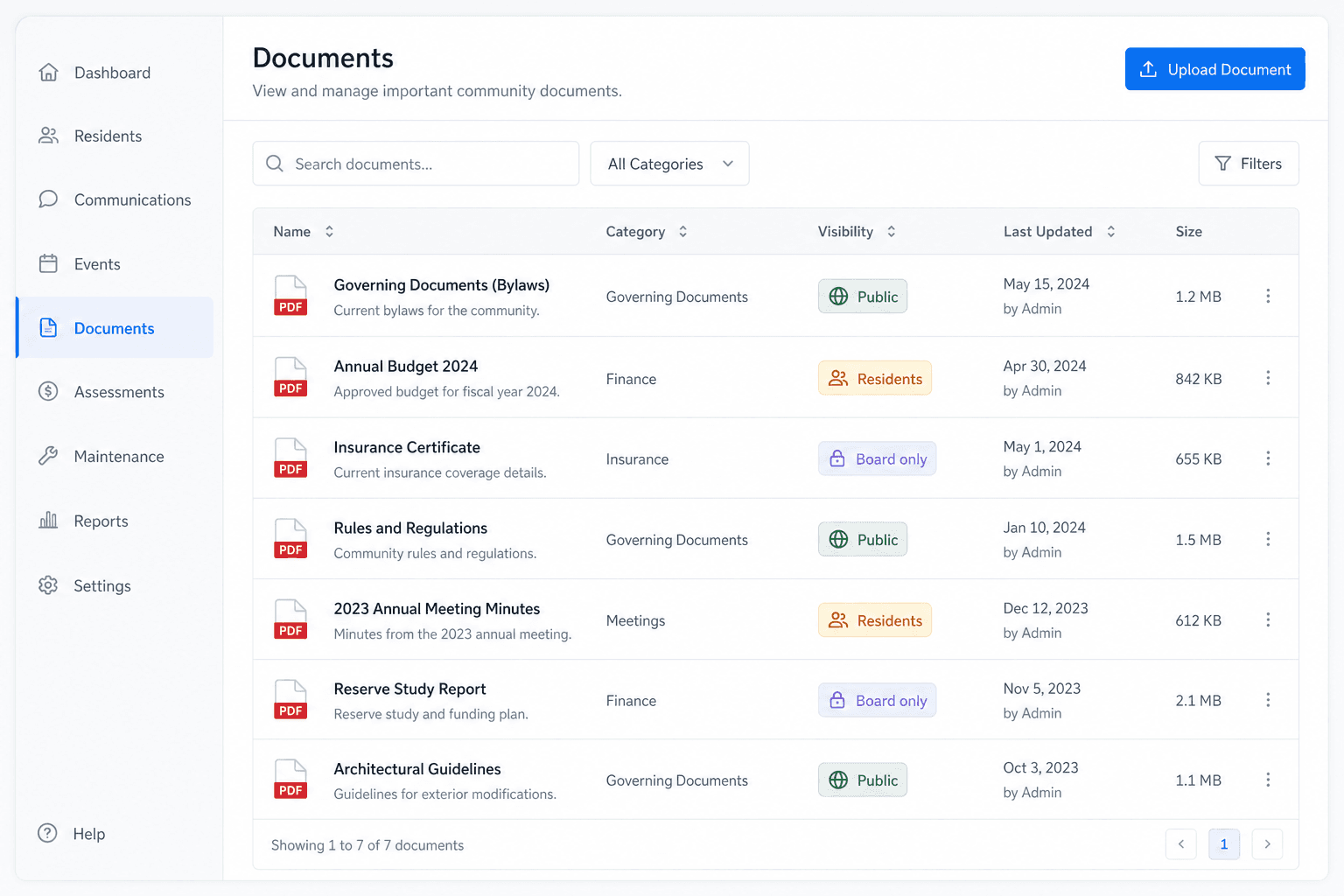
Document visibility: choose Public, Residents, or Board-only for each file — protected access is not the same as a public page. 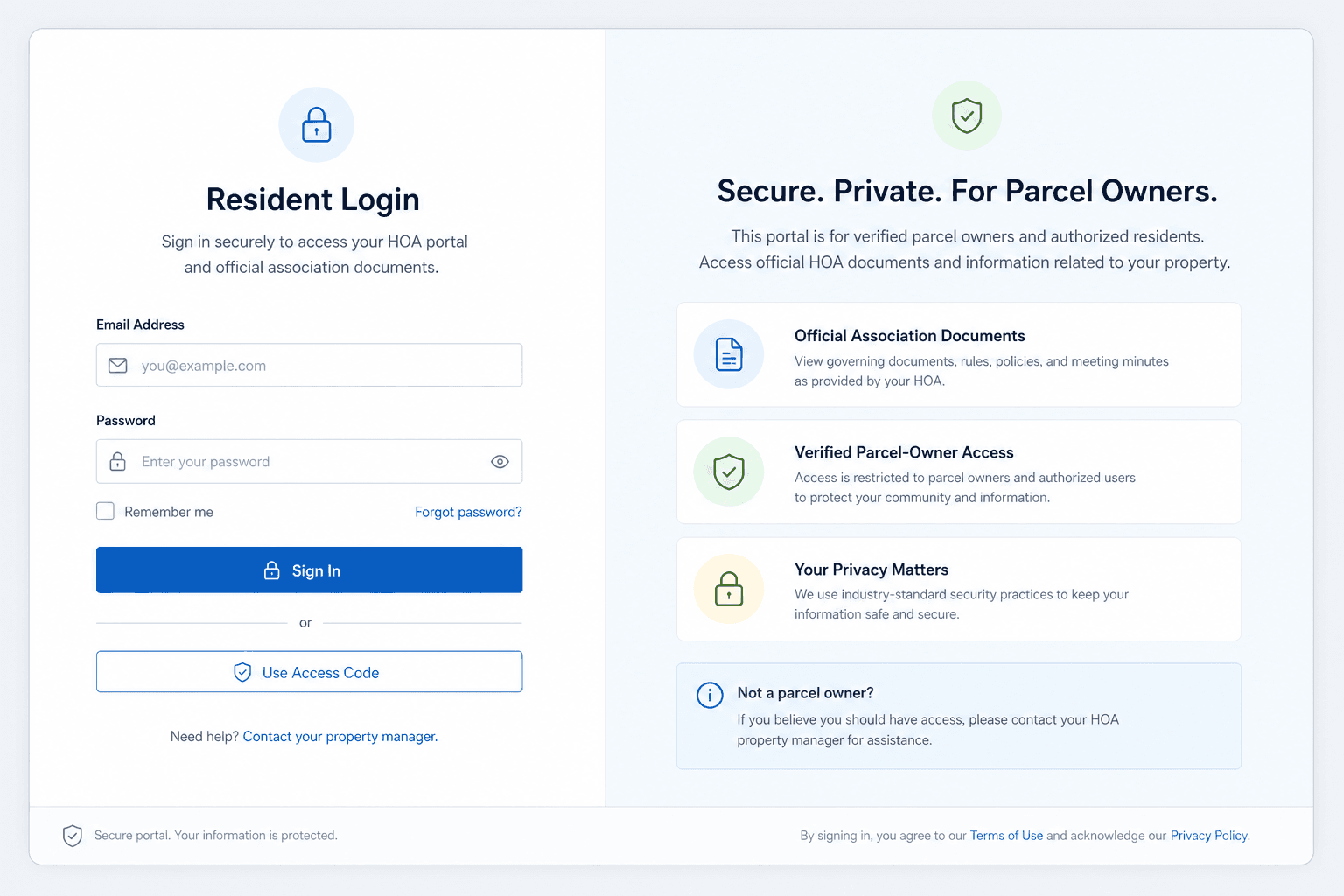
Protected access: approved residents and parcel owners sign in to reach resident-only official records. 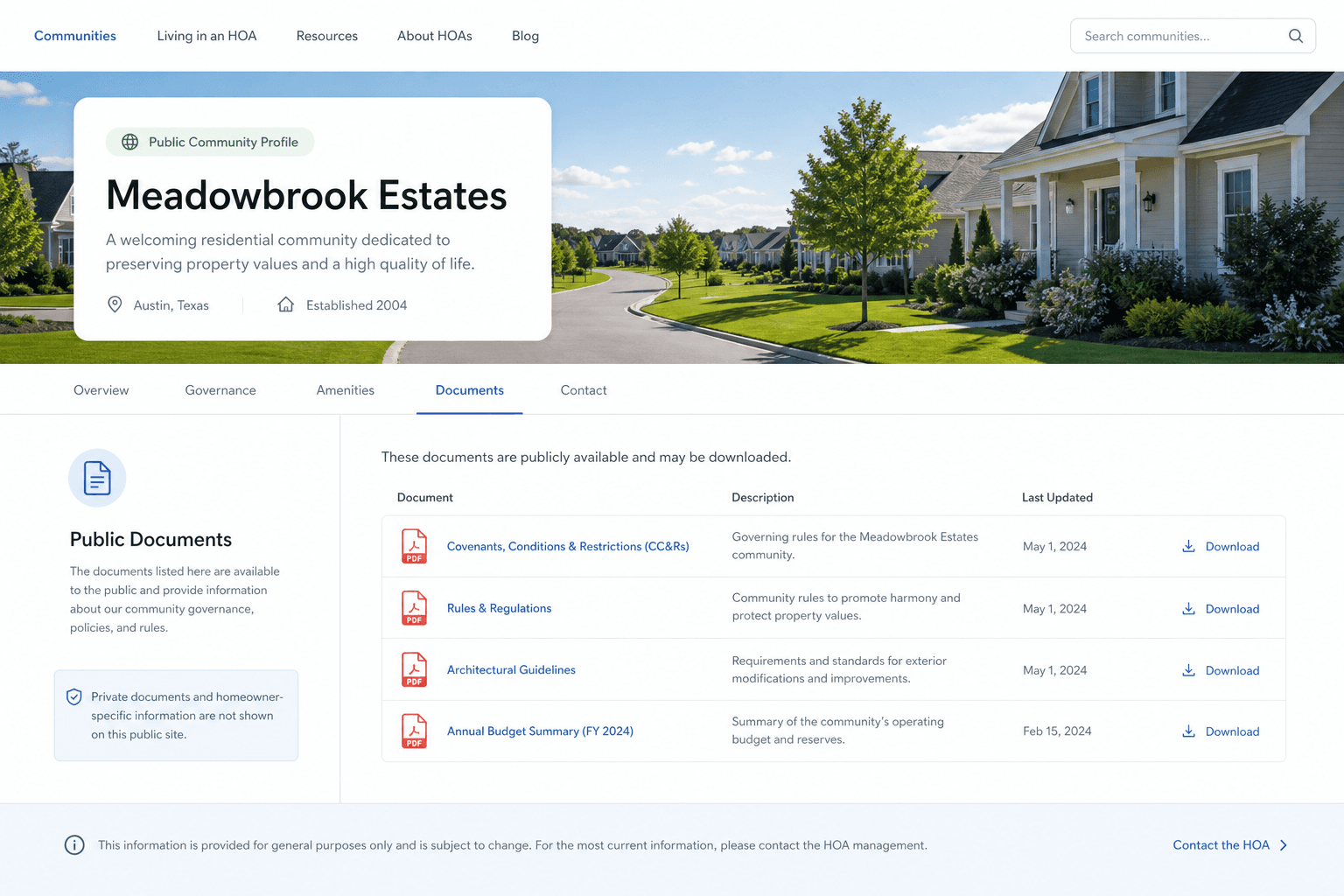
Public profile documents: optional public downloads for buyers and neighbors — separate from protected parcel-owner sections.